


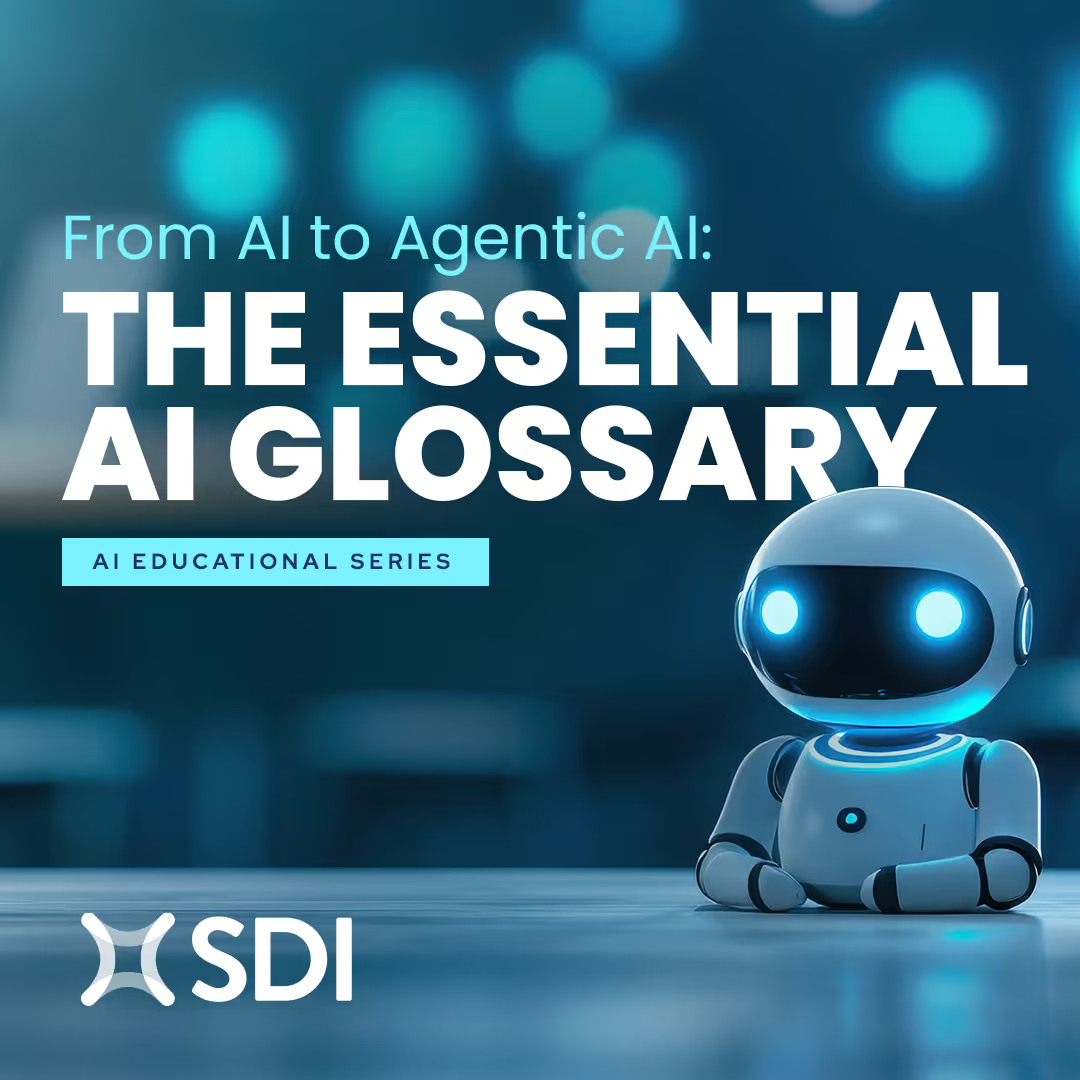
If it feels like AI conversations suddenly became their own language overnight, you’re not imagining it.
One minute it was automation. Then came generative AI, LLMs, copilots, and now agentic AI. Somewhere along the way, everyone started nodding along in meetings while secretly Googling acronyms afterward.
As organizations move from AI experimentation into real-world execution, understanding the language behind AI is becoming increasingly important. Below are some of the most common AI terms shaping conversations across government and enterprise technology today.
AI Agent
A software-based AI assistant that can complete tasks, make decisions, and interact with systems or users.
AI Governance
Policies and oversight structures designed to ensure AI is used responsibly and securely.
AI Readiness
An organization’s level of preparedness to successfully adopt and scale AI technologies.
Agentic AI
AI systems capable of autonomously planning, reasoning, and taking action to achieve goals.
AIOps
The application of AI and machine learning to automate and improve IT operations.
Artificial Intelligence (AI)
Technology that enables machines to simulate human intelligence, including reasoning, learning, and decision-making.
Automation
Technology that performs tasks or processes with minimal human intervention.
Computer Vision
AI that enables machines to interpret and analyze visual information.
Data Governance
The framework for managing data quality, security, ownership, and compliance.
Data Lake
A centralized repository that stores large volumes of structured and unstructured data.
Deep Learning
A subset of machine learning using advanced neural networks to solve complex problems.
Embedding
A mathematical representation of data used to help AI understand relationships and meaning.
Explainable AI (XAI)
AI designed to provide understandable reasoning behind its outputs or decisions.
Fine-Tuning
Additional training on a specialized dataset to customize a model for a specific use case.
Foundation Model
A broadly trained AI model designed to support many different tasks and applications.
Generative AI (GenAI)
AI systems that create original content such as text, images, code, audio, and video.
Guardrails
Policies, permissions, and controls that define what AI systems can and cannot do.
Hallucination
When an AI system confidently generates inaccurate or fabricated information.
Inference
The process of an AI model generating responses or predictions from new data.
Large Language Model (LLM)
A massive AI model trained on huge amounts of text to understand and generate human language.
Machine Learning (ML)
A branch of AI where systems learn patterns from data to improve performance over time.
Master Data Management (MDM)
The process of creating a trusted, consistent source of core business data.
Model Training
The process of teaching an AI model using large datasets.
Multimodal AI
AI capable of processing multiple forms of data, such as text, images, audio, and video.
Natural Language Processing (NLP)
AI technology that enables machines to understand, interpret, and generate human language.
Neural Network
A layered computational model inspired by how the human brain processes information.
Prompt Engineering
The practice of crafting effective instructions to guide AI responses and outputs.
Responsible AI
The development and deployment of AI that is ethical, transparent, fair, and accountable.
Retrieval-Augmented Generation (RAG)
A method that combines AI generation with trusted external data sources to improve accuracy.
Token
A chunk of text processed by an AI model, such as a word or part of a word.
Vector Database
A database optimized for storing and searching embeddings used in AI applications.
AI isn’t just changing how organizations work — it’s changing how we talk about work. As terms like agents, orchestration, and guardrails become part of everyday conversations, the real shift is happening behind the scenes: AI moving from a helpful tool to an active part of how tasks get done. The next step isn’t just keeping up with the language — it’s understanding what it unlocks.
If your organization is exploring how to move from AI experimentation to practical, secure, and scalable outcomes, SDI can help. From data governance and AI readiness to responsible agentic AI strategies and operational execution, our team helps organizations build the foundation needed to turn AI potential into measurable business value. Contact SDI Presence to start the conversation.



.avif)
.avif)

.avif)